
Personal Leadership · Bukit View Primary School · June 2026
The Morning 199 Nine-Year-Olds
Learned That No One Wins Alone
Four children stood inside a hula hoop, holding hands in a circle, and were told to pass the hoop all the way around the ring without letting go of one another. The first attempt was a tangle of elbows and giggles. The hoop got stuck on a shoulder. Somebody’s arm went the wrong way. And then one child, without being asked, crouched low so the hoop could slide over him more easily, and the rest of the group copied him. The hoop came free. The cheer that followed was louder than anything a worksheet has ever produced.
That is what teamwork looks like to a Primary 3 pupil. Not a definition on a slide, but the moment you realise that helping the person next to you is how you both get through.
Bukit View Primary School wanted an entire cohort to feel that. Not one class, not a handful of chosen pupils, but every Primary 3 child, learning together that a class is only ever as strong as the way it looks after its own.
What Bukit View Primary School Needed
At Primary 3, friendship groups are forming, cliques are hardening, and the children who get left out are often the quietest ones in the room. Bukit View Primary School had a clear conviction about the year ahead, captured in a single line: every Bukit Viewan, a peer supporter. They wanted their whole Primary 3 cohort to grow into a class community where children include rather than exclude, cooperate rather than compete, and know that asking for help is a brave thing rather than a weak one. This is not something a single assembly can deliver. It needed every class to experience the same lessons on the same morning, in a way a nine-year-old would remember long after the games ended. Bukit View engaged Leaven Academy to design and run a cohort-wide team building programme that would make peer support something the children had lived, not just been told about.
How We Designed It
We built the programme on the Leaven Learning Cycle, our applied form of Kolb’s Experiential Learning Cycle, so that every value was experienced through activity first and only then drawn out in reflection. The children did not sit and listen to a talk about teamwork. They ran into the problems teamwork solves, and discovered the answers with their own hands.
The morning opened in the school hall with a cohort ice-breaker built around a simple, powerful idea: no one should be left standing on the outside, and everyone has the power to bring a classmate in. Back in their classrooms, pupils worked first in pairs with their assigned Class Buddy, then in larger groups, through a sequence of challenges.
The Law of the Chain showed them that a team is only as strong as its weakest link. The story of Singapore’s national netballers, who cannot score without trusting their teammates in every zone, gave them a picture of role clarity and trust they instantly understood. Through the Hoop and Blind Shapes turned those ideas into physical, unforgettable experiences.
Everything pointed towards the U.N.I.T.E. principles, a simple framework that gives young children a shared language for how to support one another. The morning closed with One Good Thing, where every child wrote down something they had genuinely appreciated about a classmate, so that each pupil went home holding proof, in their friends’ own handwriting, that they belonged.
Six Trainers ran six classes in parallel, one coach per class, so no child was ever more than a few steps from an adult who knew their name that morning.
The Moment That Mattered Most
It was quiet, and it came near the end. During Blind Shapes, pupils took turns being blindfolded while their group guided them by voice alone to form a shape on the floor. The activity depends entirely on trust, on the blindfolded child believing their classmates will not let them stumble. When it was over, each group spent a minute telling one another what they had done well. In one classroom, a child who had spent much of the morning on the edge of the group was told by a teammate that he had been the calmest, clearest voice when everyone else was panicking. He had not known anyone had noticed. That is the whole aim of peer support in one small exchange, a child discovering he mattered to the group, told so by the group itself.
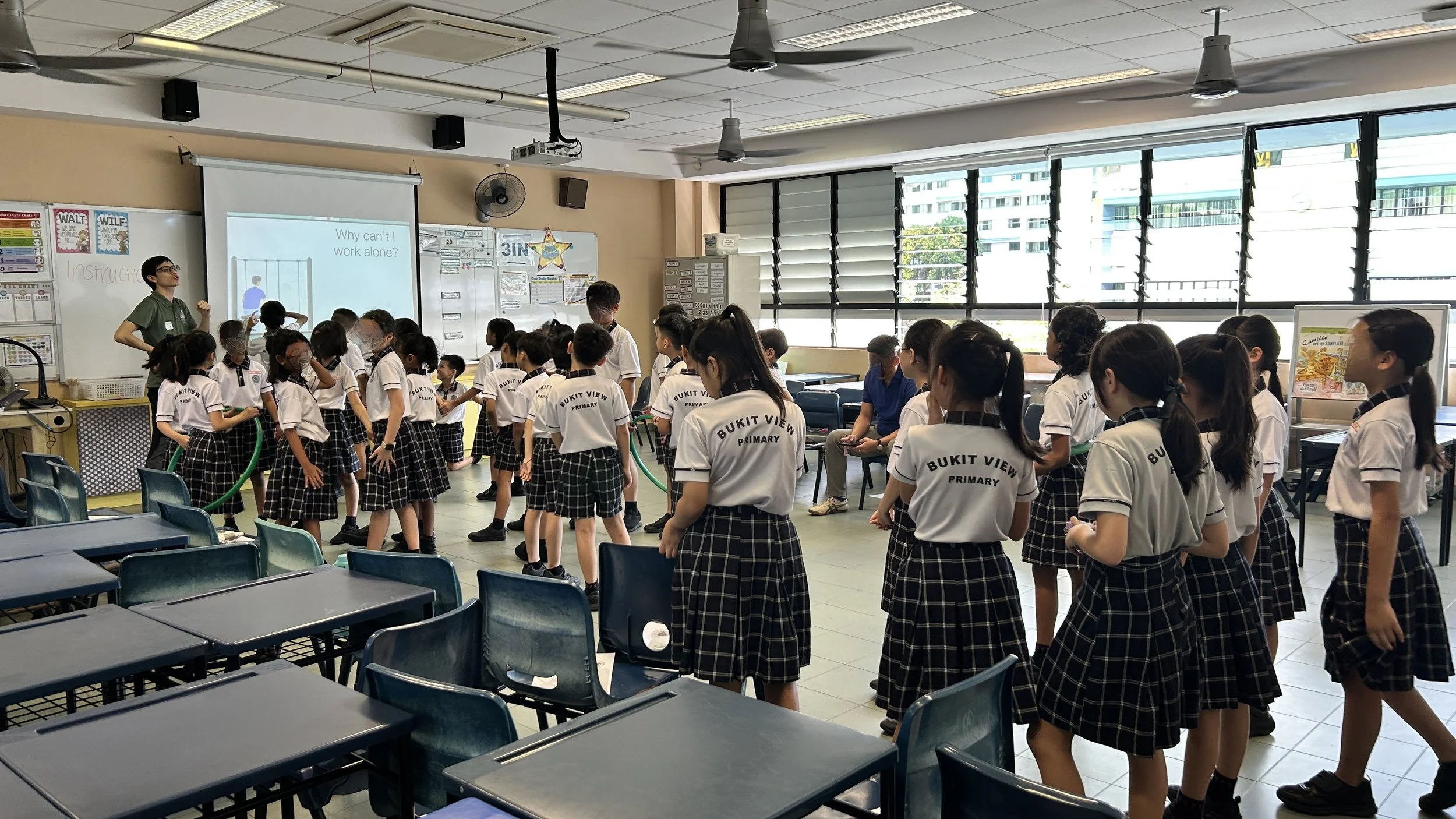
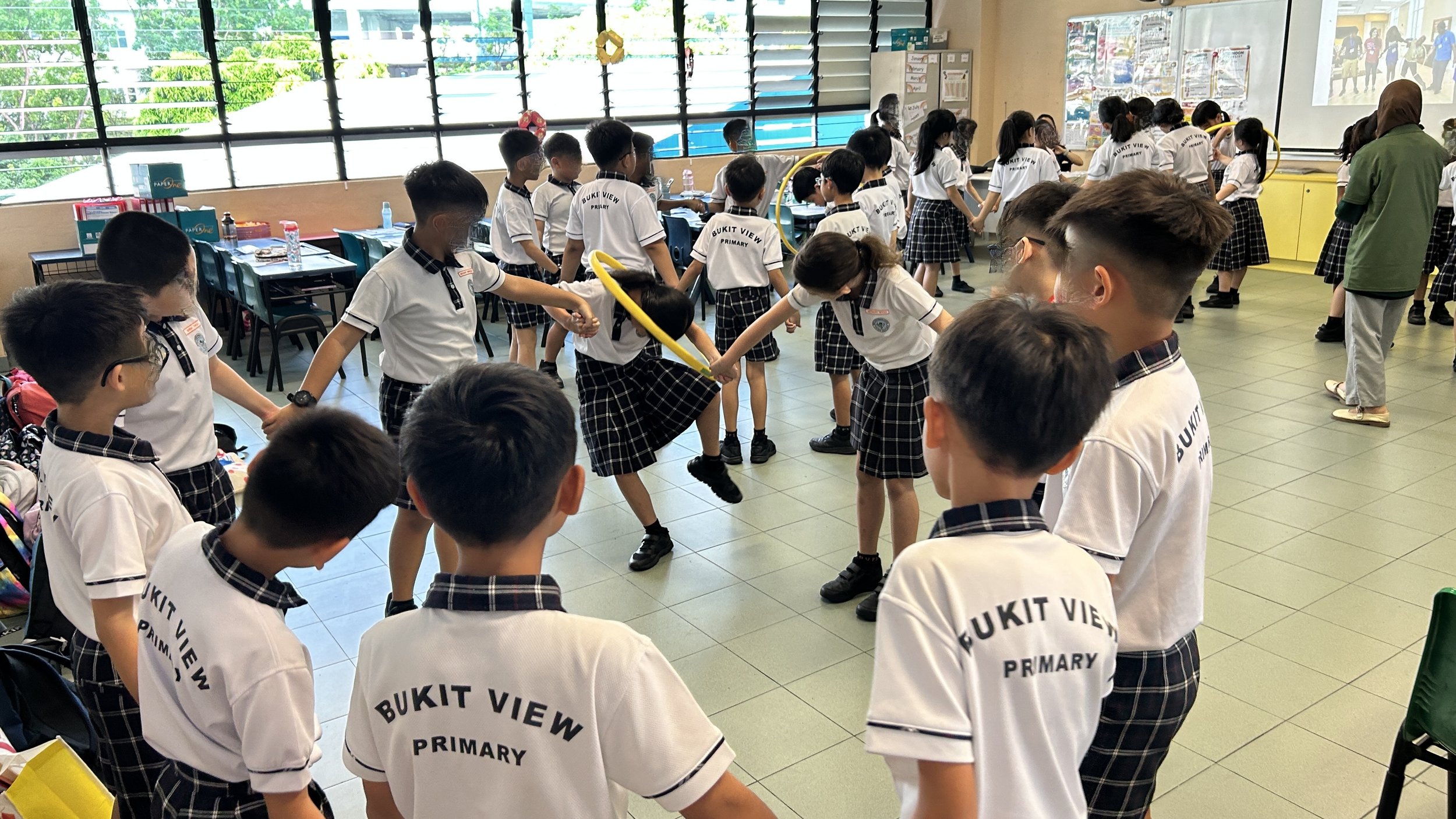
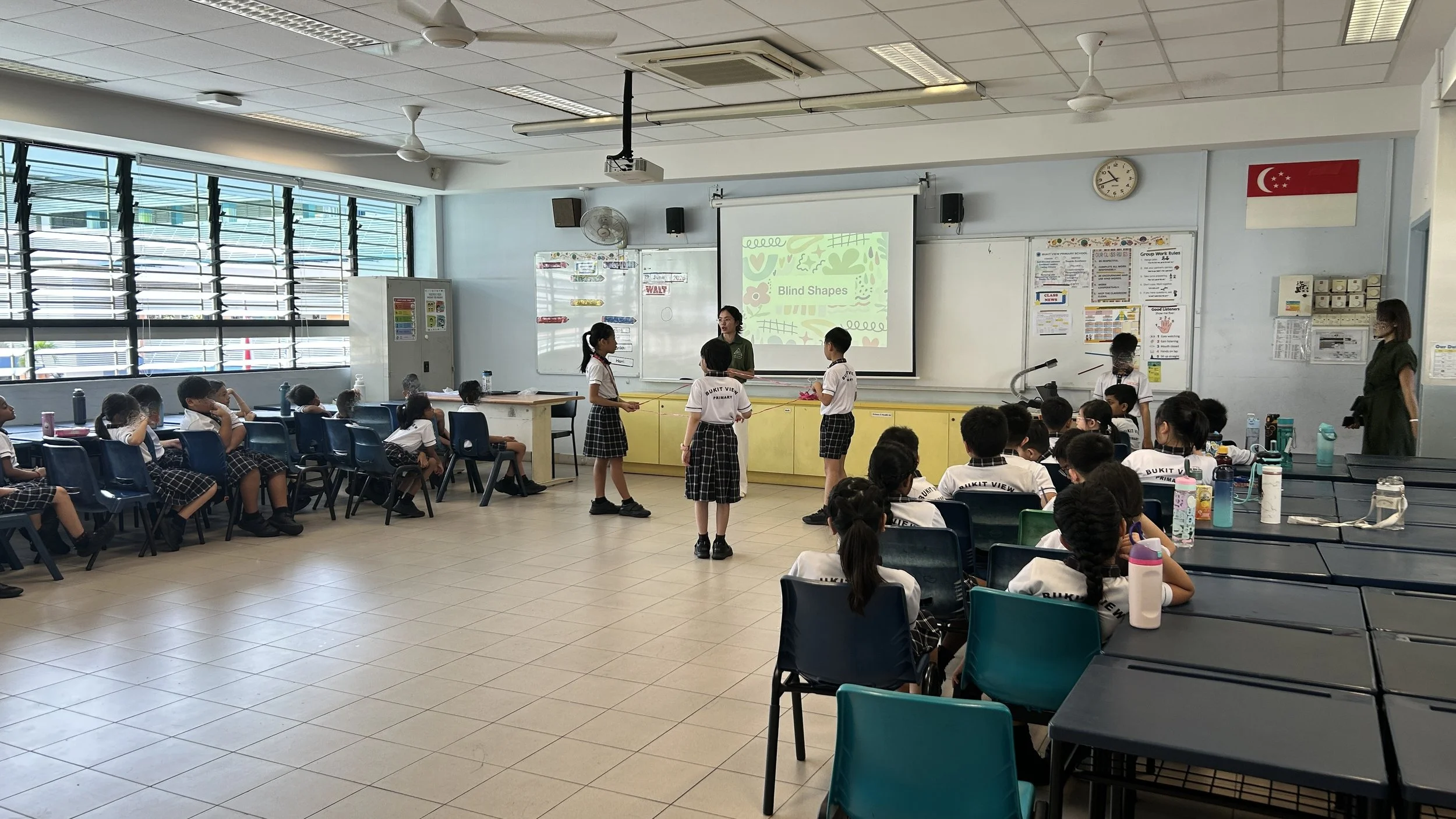
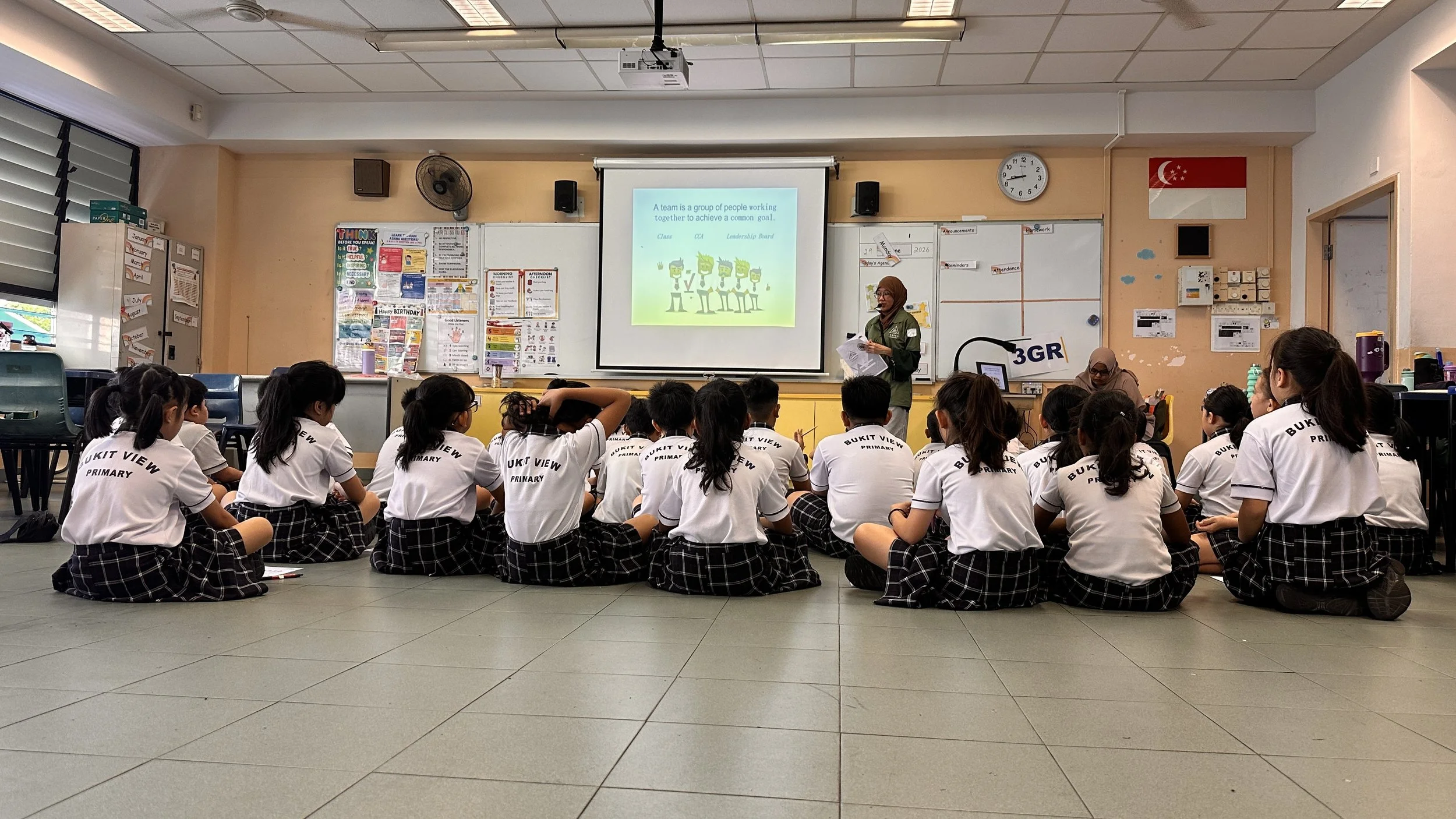
Bukit View Primary pupils engaged in the different activities during the workshop
What the Numbers Said
Across the whole Primary 3 cohort, pupils rated the programme’s overall effectiveness at 85.3% and coach effectiveness at 91.0%, with 199 pupils taking part across six classes in a single morning. The strongest single result was on the question that matters most for a peer support programme: the overwhelming majority of children said they now understood why teamwork is important and had enjoyed the workshop. For nine-year-olds, that combination of understanding and enjoyment is exactly the soil in which a supportive class culture takes root.
Three Things That Made the Difference
A whole cohort, not a chosen few. Peer support only works if everyone is in the room. Running all six Primary 3 classes through the same programme on the same morning meant no child was left out of the very lesson about not leaving children out. The message and the method matched.
Feelings before framework. The U.N.I.T.E. principles were never taught cold. By the time the children met the framework, they had already felt what it named, the tangle of the hoop, the trust of the blindfold, the relief of being brought back into the circle. The words simply gave a home to something they had already experienced.
Ending on belonging. The final activity did not ask children to remember facts. It asked them to notice the good in a classmate and to receive the good a classmate had noticed in them. Sending every child home with a handful of kind words in their friends’ handwriting is how a one-morning programme becomes something a child carries for far longer.
Thinking About Something Similar for Your Students?
Leaven Academy works with secondary schools, polytechnics, ITE colleges, junior colleges, and youth organisations across Singapore to build the facilitation, leadership, and communication capability that formal titles alone do not teach.
If you have student leaders who could use the same kind of practical, hands-on preparation, we would be glad to talk through what that could look like for your school.
“he conflict management activity because it was something I have never tried before and it was eye opening that we had many misunderstandings.”
“I enjoyed Coach Victor’s way of presenting as it taught me to be more confident in myself. The way I talk or present to a group of people, I will apply what I have learnt here.”
“I liked the way my instructor taught us the different methods to cope with conflict.”