
How To Teach Kids Wants VS Needs
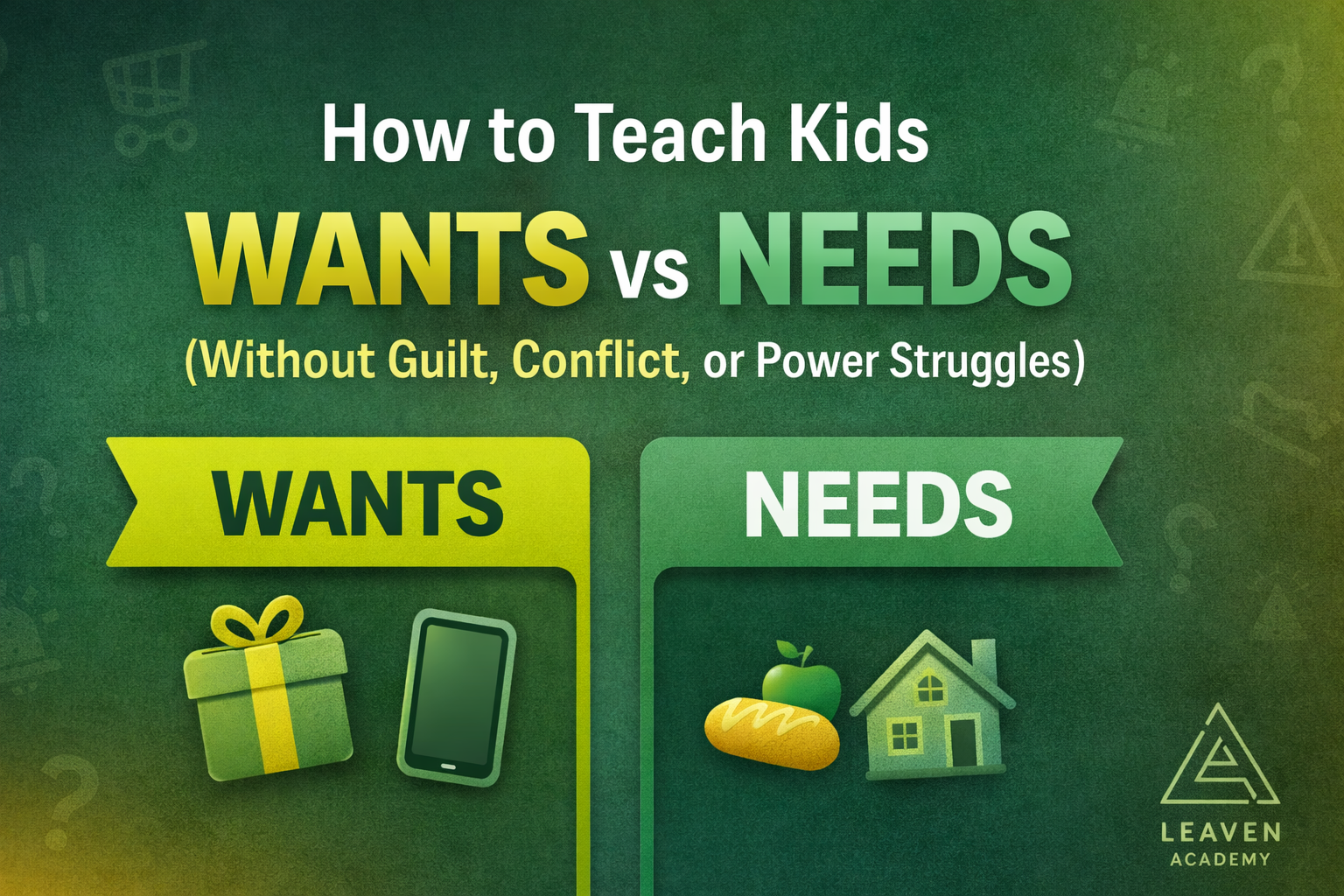
Many parents want to teach their children the difference between wants and needs, but unknowingly create a problem in the way they explain it.
One of the most common mistakes I see is when parents frame wants versus needs as a good versus bad issue.
Needs are “good”. Wants are “bad”.
That framing is not only inaccurate — it can be dangerous.
There is nothing wrong with wanting something. At the same time, not every want should be fulfilled immediately. Teaching children wants versus needs is not about morality. It is about decision hierarchy and priority.
Why Wants vs Needs Should Never Be “Good vs Bad”
When wants are labelled as “bad”, children either feel guilty for wanting things — or they learn to hide their desires.
Neither outcome is healthy.
In our household, we frame wants and needs very clearly as an order of fulfilment, not a moral judgement:
Needs are fulfilled first
Wants are considered only if resources allow
This removes shame from the conversation and replaces it with reasoning.
When Is a Child Ready to Learn Wants vs Needs?
This is not about age.
It is about reasoning ability.
I’ve noticed that the moment a child can explain why they chose option A over option B, they are ready for this conversation.
Once my child could tell me, “I chose this because…”, it became possible to explain why a decision made sense or didn’t. At that point, explanations stopped feeling like lectures and started feeling like discussions.
A Simple Decision Hierarchy Children Understand
In my own explanations to my children, I keep it very concrete.
I ask one key question:
“If we don’t have this, will we suffer a terrible consequence?”
To simplify it even further for younger children, I use an extreme but clear outcome:
If not having something could lead to death, it is a need
If not having it does not cause serious harm, it is a want
Food and water are obvious needs.
Housing, in modern society, is also a need because it protects us from danger.
Wants, on the other hand, make us feel happy — but we will survive without them.
Where Parents Commonly Confuse Wants as Needs
One example I see often is during mealtimes.
When I’m out eating with my family, I frequently notice parents placing a phone or tablet in front of their child and treating it as necessary — so the child will eat, stay quiet, or avoid causing a scene.
In reality, the screen is not a need.
It is a want used for convenience.
The same confusion happens with enrichment classes, entertainment, and devices. Over time, these wants quietly become framed as needs — not because children require them, but because adults feel pressure.
Helping Children Handle Emotional Wants
Emotional wants feel urgent.
When a child is overwhelmed, logic does not work immediately. In those moments, my priority is not explanation — it is calming.
Sometimes, that means distracting the child with something else. Not to manipulate them, but to help them settle emotionally.
Once they have calmed down, I revisit the situation:
“Earlier, it felt like you really needed that. But after calming down, you were okay without it. Does that help us decide whether it was a need or a want?”
This helps children realise that emotions can feel powerful — but they pass.
Why I Avoid Saying “No” Immediately
One thing I consciously avoid is immediately saying “no”.
An instant rejection shuts down thinking. Instead, I ask questions.
For example, when one of my sons asks for a toy, I might say:
“Why do you think you need this?”
“What does this help you with?”
“Do you already have something that does the same thing?”
This is not about shaming them. It is about understanding their reasoning.
If their answer does not make sense, I tell them gently:
“That answer doesn’t quite add up. You might want to think about it a bit more.”
Validating Feelings Without Giving In
Validation does not mean agreement.
I often say:
“I understand you really want this. It matters to you.”
Then I provide evidence:
“You already have something similar.”
“You’ve already had enough screen time today.”
Children learn that their emotions are acknowledged — but decisions still require reasoning.
How This Builds Emotional Regulation Over Time
Something interesting happened after I started using this approach.
Before even asking for something, my child began preparing answers. He already knew the kinds of questions I would ask.
That shift told me everything.
He wasn’t just reacting emotionally anymore — he was thinking ahead. This is how emotional regulation develops: through repeated calm reasoning, not punishment or indulgence.
Why Parents Must Model Wants vs Needs
There is a phrase I hold closely:
Values are not taught. They are caught.
Parents are the most influential influencers in a child’s life.
If we preach restraint but spend impulsively, children notice the double standard immediately.
That is why my wife and I regularly discuss purchases out loud — in front of our children. We explain why we agree something is a need, or why we choose not to buy something even if others do.
This models that money decisions are thoughtful and collective, not impulsive.
The Long-Term Risk of Not Teaching This Early
I recently watched a podcast featuring someone who achieved financial independence. One key observation stood out:
There are people who earn a lot of money — and still end up with very little.
Why?
They never learned to control their wants.
When everything feels like a need, spending becomes emotional. Lifestyle inflation and peer pressure take over. Even high income cannot save someone from poor judgement.
This is why teaching wants versus needs early matters so much.
A Simple Reframe for Tired Parents
A need is something you must have to survive.
A want is something you can live without, even if it feels important.
One Small Change to Start This Week
Start talking through your purchase decisions openly at home.
When parents reason calmly, listen to one another, and explain their choices, children naturally learn to do the same with their own money.
If you are a parent looking to bring financial literacy to your child through an experiential workshop, you can recommend us to your school, by sending them our webpage. We conduct financial literacy programmes for schools in Singapore.