
The Money Maturity Ladder: How to Tell If Your Child Actually Understands Money
The Real Test of Whether a Child Understands Money
Many parents believe their child understands money.
After all, the child can recognise money.
They know how much things cost.
They can even count it.
But the real test is not whether a child recognises money.
The real test is what the child does the moment money enters their hands.
Because something interesting often happens.
Two children can receive the exact same amount of money…
and make completely different decisions.
One child spends everything immediately.
The other child pauses… and keeps most of it.
Same age.
Same ten dollars.
Completely different behaviour.
The difference is not intelligence.
The difference is money maturity.
Financial maturity does not appear automatically with age. It develops step by step through repeated decisions.
In this article, I want to introduce a simple framework called the Money Maturity Ladder — five stages that reveal whether a child truly understands money, or simply recognises it.
Prefer Watching Instead?
The Hidden Difference Between Financial Knowledge and Financial Maturity
Over the years working with parents and children, I have noticed something very consistent.
Many parents tell me:
“My child already knows about money.”
And they are not wrong.
Children often know:
what money looks like
how much things cost
how to count money
But something changes when money actually enters their hands.
The money disappears immediately.
The child buys things they already have.
Or they buy something simply because it looks attractive in the moment.
And when you ask why they bought it, they often cannot explain.
This reveals something important.
Financial knowledge is not the same as financial maturity.
Knowing what money is…
is very different from knowing how to use money wisely.
Financial maturity is not knowledge.
Financial maturity is decision capability.
The Money Maturity Ladder
I often explain financial development using a framework called the Money Maturity Ladder.
Because children do not suddenly become wise with money.
They develop step by step.
The ladder contains five stages:
Discernment
Discipline
Decision Judgment
Resource Stewardship
Financial Character
Children move gradually through these stages as their thinking about money develops.
Understanding these stages helps parents recognise where their child currently stands.
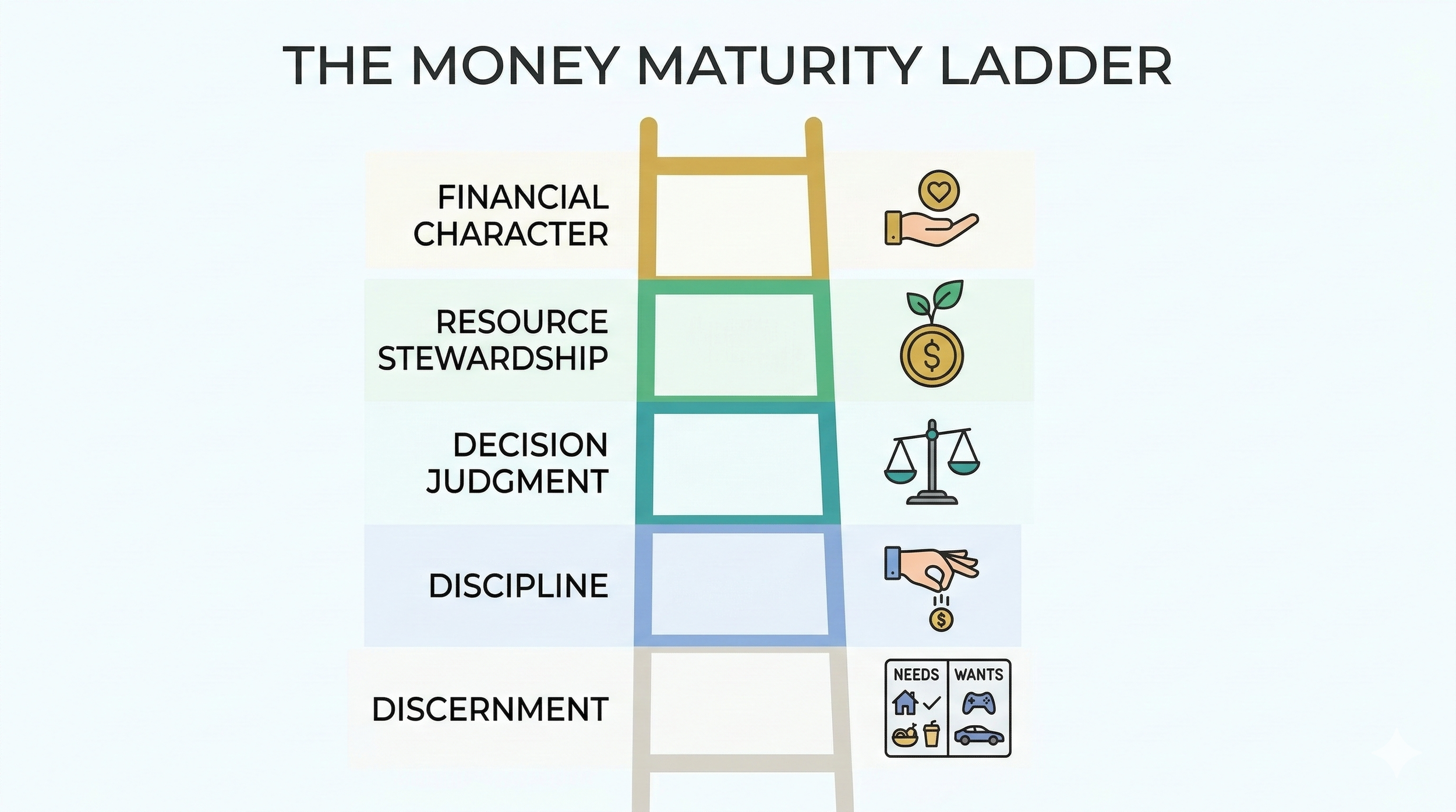
Children move gradually through these stages as their thinking about money develops.
Understanding these stages helps parents recognise where their child currently stands.
Stage 1 — Discernment
Discernment is the ability to recognise the difference between needs and wants.
For example, a child might realise:
“I don’t actually need another toy.”
This may sound simple, but it is the beginning of financial maturity.
Before a child can control spending, they must first recognise which spending is necessary and which is optional.
Discernment is where money maturity begins.
If you want practical ways to teach this idea to children, you may find this guide helpful:
Teach Kids Wants vs Needs Properly
https://www.leavenacademy.com/blog/teach-kids-wants-vs-needs
Stage 2 — Discipline
The second stage is discipline.
Discipline is the ability to delay gratification.
Instead of spending immediately, the child can pause and wait.
For example, my own children sometimes choose to bring snacks from home instead of buying snacks in school.
The snack from home is free.
Which means they keep their allowance.
Sometimes that money even goes into their savings account and earns interest.
What matters here is not the money.
It is the thinking.
They are choosing a free option now so they can preserve resources for later.
Discipline protects money from impulse.
If your child struggles with impulse spending, you may also find this helpful:
How to Stop Child Impulse Buying
https://www.leavenacademy.com/blog/how-to-stop-child-impulse-buying
Stage 3 — Decision Judgment
The third stage is decision judgment.
At this stage, children begin evaluating alternatives before making a purchase.
Instead of reacting immediately, they begin asking questions such as:
Is this worth buying?
Do I really need this?
Could this money be used for something better later?
Spending becomes a decision rather than a reaction.
Judgment turns spending into decision-making.
Stage 4 — Resource Stewardship
The fourth stage is resource stewardship.
Children begin thinking beyond today.
They may start:
saving intentionally
avoiding unnecessary purchases
watching their savings grow
Money is no longer just something to spend.
It becomes something to manage and protect.
Stewardship treats money as a resource.
Stage 5 — Financial Character
The final stage is financial character.
At this stage, children begin to understand that money carries responsibility.
Money is not only for spending.
It can also be used to give and help others.
Children may begin to share with others or support causes they care about.
Money becomes connected to values.
This is what completes the Money Maturity Ladder.
What Parents Can Do This Week
You do not need a complicated lesson to understand your child’s financial maturity.
You only need a simple observation.
Give your child a small amount of money.
For example:
ten dollars.
Then watch what happens.
Some children will spend everything immediately.
They might buy sweets or something attractive in the moment.
Other children might pause.
They may save part of it.
They may think about future purchases.
Same ten dollars.
Completely different thinking.
And that difference often reveals where a child stands on the Money Maturity Ladder.
Final Thought
Financial maturity is not about how much money a child has.
It is about how the child thinks about money.
Do they recognise needs and wants?
Can they delay spending?
Do they evaluate decisions?
Do they protect resources?
And eventually, do they develop financial character?
Money maturity reveals itself through decisions.
If your child received ten dollars today… what would they actually do with it?
The answer may reveal more about their financial maturity than any lesson about money.
Because mastering money begins with learning how to make better decisions — and those decisions begin early in life.
If you are a parent looking to bring financial literacy to your child through an experiential workshop, you can recommend us to your school, by sending them our webpage. We conduct financial literacy programmes for schools in Singapore.