
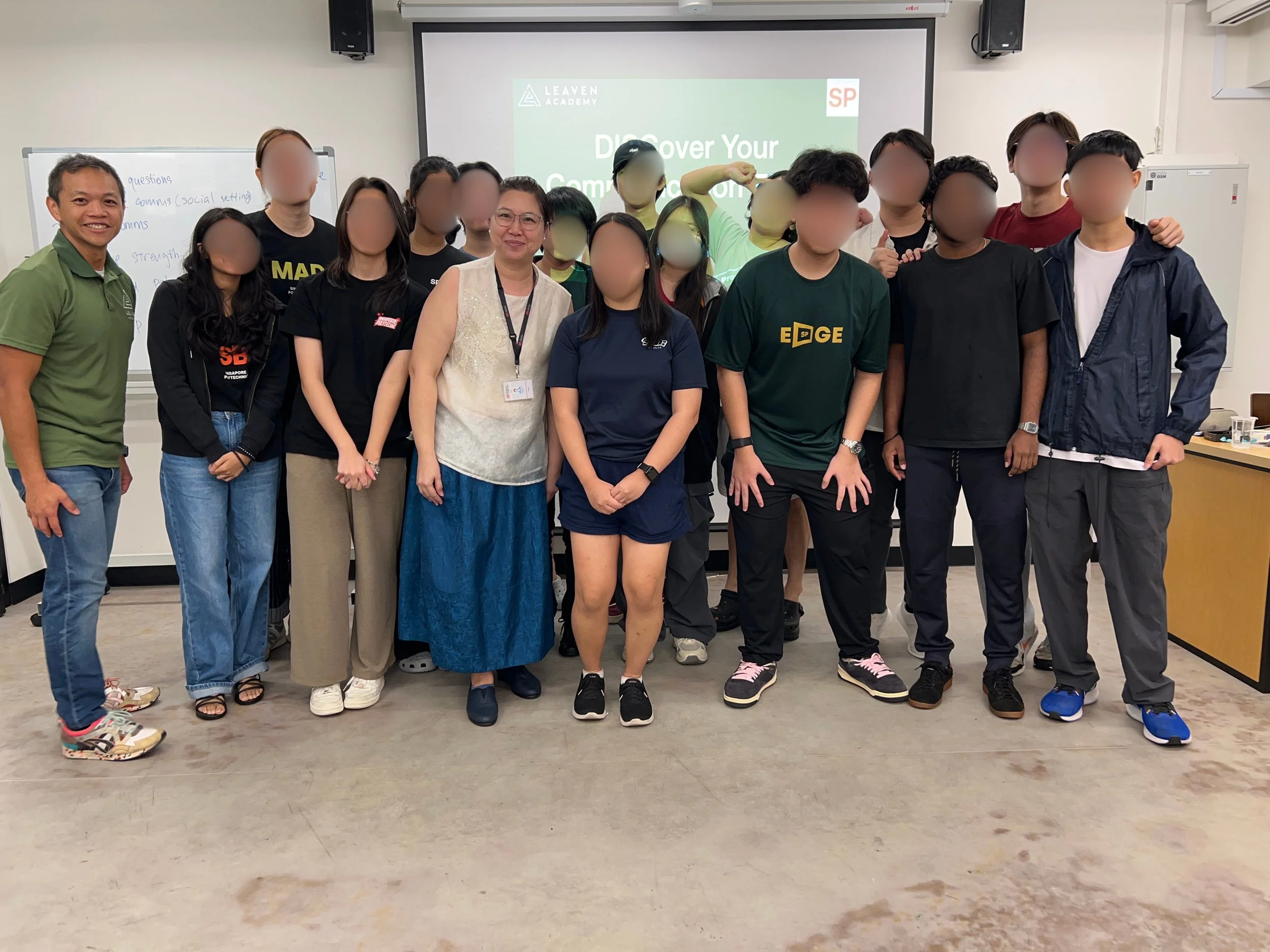
Communication Mastery · Singapore Polytechnic · June 2026
They All Looked at the Same Picture. They Did Not All See the Same Thing.
Two optical illusions. One room of thirteen students. And a question that took less than sixty seconds to answer.
Coach Ernest placed the images at the front of the room at the start of the Singapore Polytechni DISCover Your Communication EDGE Workshop and asked simply: what do you see? What followed was not agreement. Students looking at the same image reported seeing entirely different colours and details. Nobody was wrong. They were simply wired to process the same visual input differently. In the space of those ten minutes, before any profiling, any theory, or any instruction, the entire premise of the day had been made visible.
That is where the workshop began. Not with a slide deck or a personality questionnaire, but with an experience that made something invisible suddenly concrete.
Over the three hours that followed, Leaven Academy worked with Year 1 to 3 Singapore Polytechnic EDGE students to build the kind of self-awareness and interpersonal intelligence that enrichment and leadership programmes need their students to carry into every team they will ever be part of. Designed in consultation with Ms Catherine Ang, the Singapore Polytechnic DISCover Your Communication EDGE Workshop 2026 was built around one conviction: that communication mastery begins not with learning to speak better, but with learning to see yourself and others more clearly.
What Singapore Polytechnic EDGE Needed
Singapore Polytechnic's EDGE programme develops students who are expected to lead, collaborate, and represent their peers across the polytechnic community. These are not students who lack ambition or initiative. What many of them lacked was a framework for understanding why their instincts in group situations sometimes produced friction rather than momentum, and why the communication approaches that felt natural to them did not always land the way they intended.
The brief from Ms Catherine Ang was built around three clear outcomes: to develop students' understanding of different communication styles through the DISC profiling framework; to equip them to become more effective leaders and collaborative team players with practical tools for working across different personality types; and to build each student's self-awareness so they could manage their own responses more thoughtfully in group situations. Leaven Academy was engaged to design and deliver a programme that would translate those outcomes from theory into lived experience.
How We Designed It
The Singapore Polytechnic DISCover Your Communication EDGE Workshop was designed using Leaven Academy's Experiential Learning Model and the MASK framework, building from Mindsets and Attitudes through to Skills and Knowledge. Every element was grounded in the same principle: that transformation happens through doing, not just hearing.
The session opened with an optical illusions exercise designed to do one thing quickly: show that two people can look at the same image and perceive it in completely different ways. Participants were shown images that presented identical visual information, yet the colours and details people reported seeing varied across the room. No one was wrong. They were simply wired differently. The exercise took less than ten minutes, and it set up every conversation that followed.
From there, the session moved into the Escape Box, a team challenge in which groups worked with case files and physical clues to solve a mystery together. Time was taken upfront to brief participants on how the activity worked, after which groups had approximately thirty minutes to complete the challenge. The Escape Box was the personality exercise, not the communication exercise. Structured to require coordination, decision-making, and leadership under mild pressure, it surfaced how each student naturally approached a group problem — who drove forward, who analysed, who held the group together, and who needed the full picture before acting. Participants did not yet have names for those tendencies. The activity simply let them emerge.
The naming happened next. A Gallery Walk through DISC personality trait printouts gave the room a shared vocabulary. Individual DISC assessments followed, with each participant receiving a personalised, laminated, colour-coded report. The facilitator walked through all four DISC dimensions in depth — Dominance, Influence, Steadiness, and Compliance — and students read their own profiles alongside the debrief. By the time this phase closed, participants understood not only their own type but those of the people they had just worked alongside.
The Impossible Tower of Cups arrived last, and this is where the communication work was explicitly layered in. Groups returned to a physical challenge — stacking cups using only rubber bands and strings, without touching them directly — but this time they brought something they had not had during the Escape Box: knowledge of each other. With their DISC profiles in hand, students were asked to communicate in a way that worked for each specific person in their group. The Tower of Cups was the application exercise, the moment where DISC moved from something students understood to something they actually used.
The Moment That Mattered Most
It happened during the Impossible Tower of Cups, and it was not loud or dramatic. It was a shift.
Students had their DISC reports. They knew, in theory, that the person next to them processed information differently, responded to direction differently, and was motivated by different things. What they had not yet tested was whether acting on that knowledge would actually change anything.
The Tower of Cups answered that question. As groups began working through the challenge, something changed in how they communicated. Students began adapting — speaking to each person in a way that leaned into how that person was wired, rather than simply repeating what had not worked the first time. Participants who had been overlooked during the Escape Box, because the group had not yet understood how they needed to receive information, were now being spoken to in a way that made sense to them. And they responded. The task moved.
The participants realised in that moment that they were each uniquely different, and that when they brought those differences together with intentionality — communicating with the knowledge of what each person needed to hear and how they needed to hear it — they became genuinely more effective as a group. That is the outcome this programme is designed to produce.
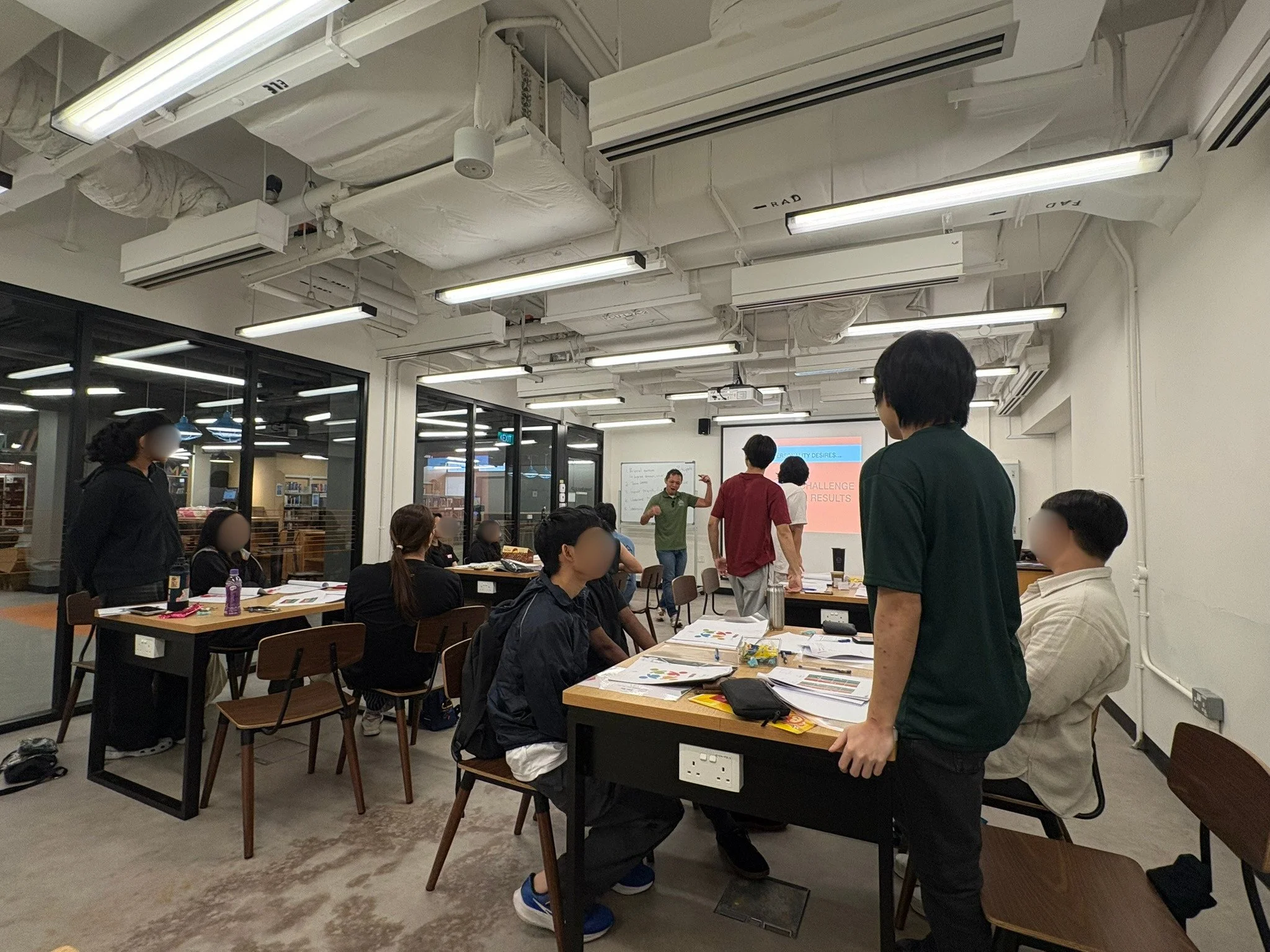
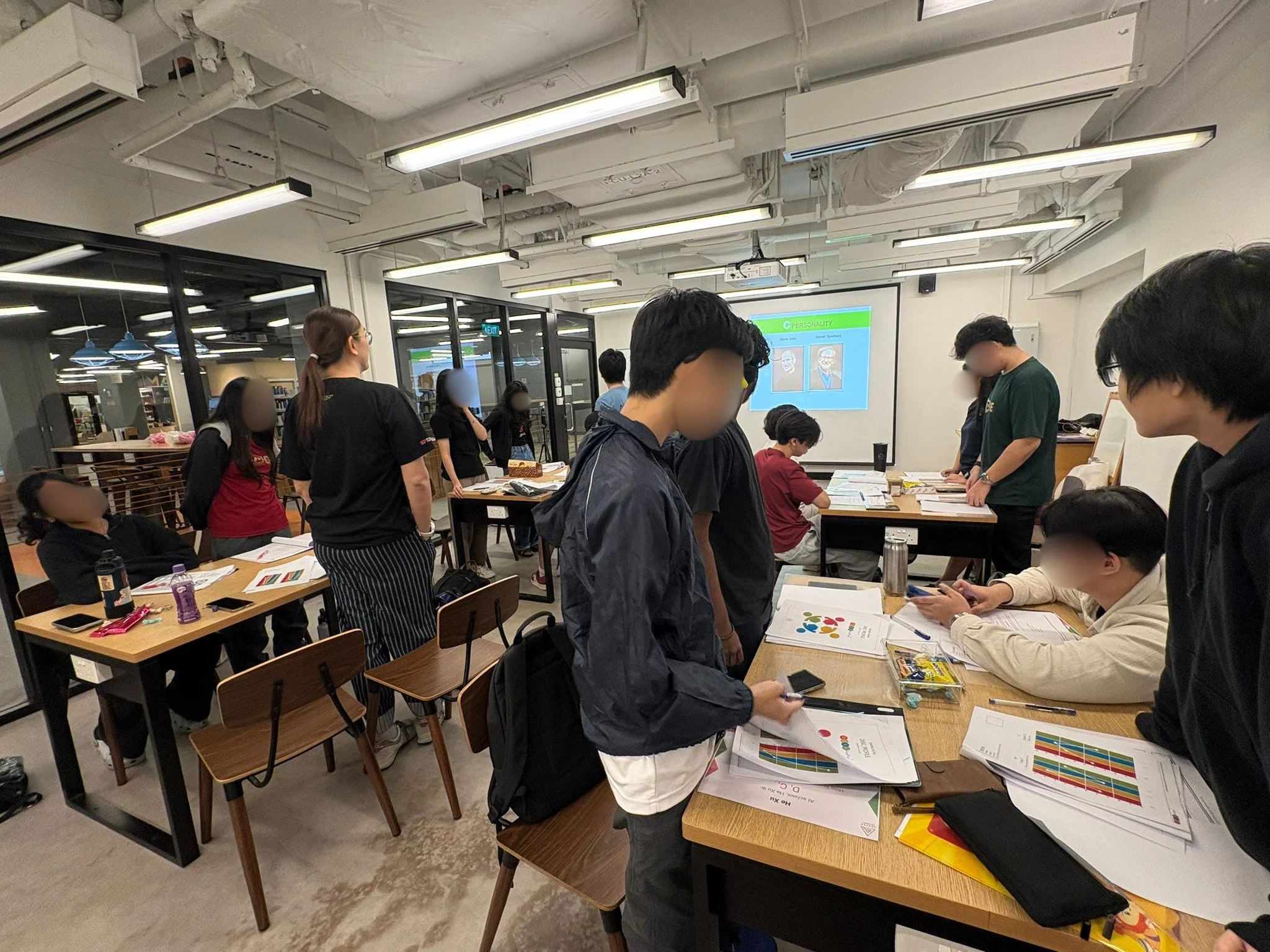
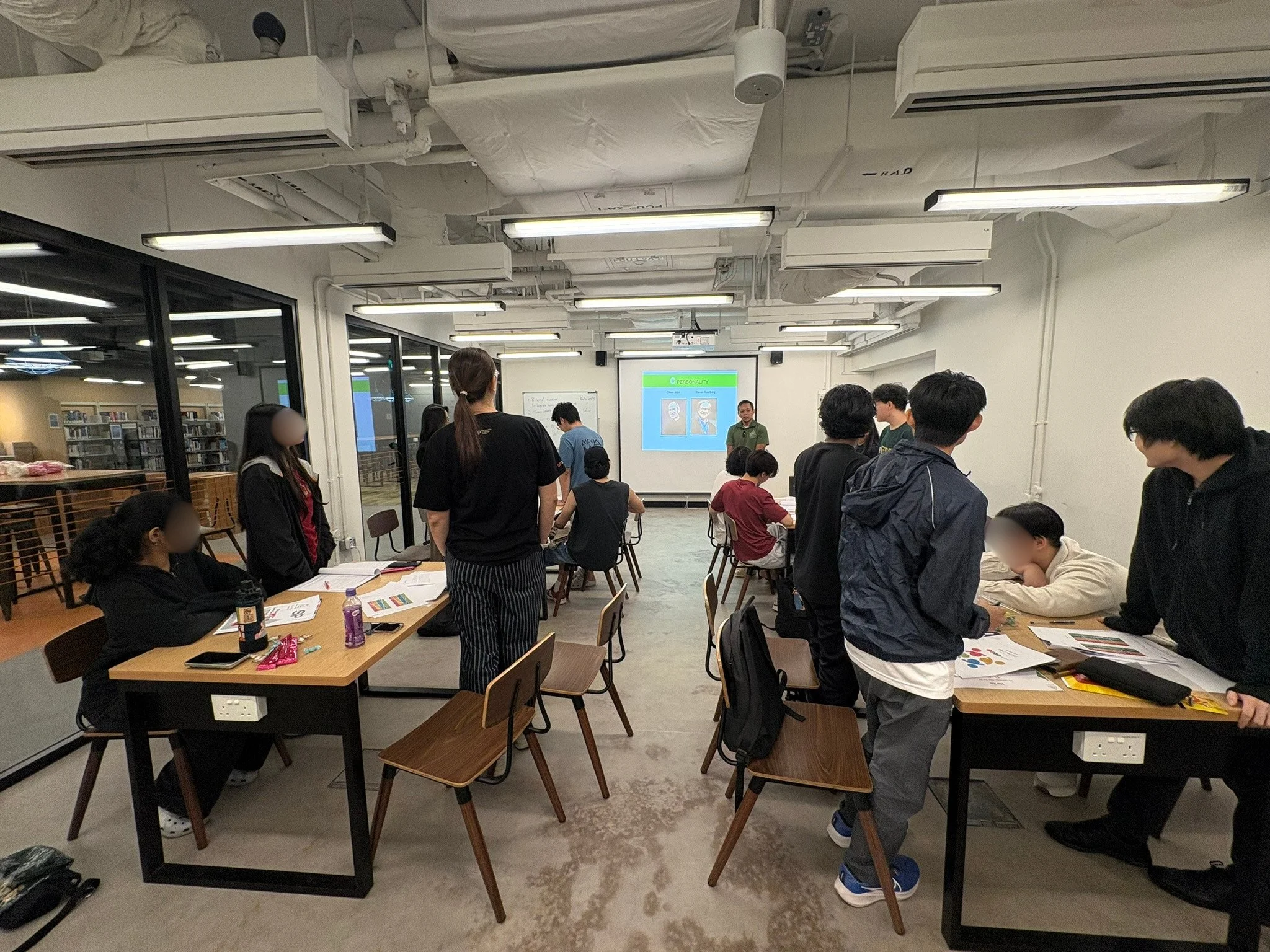
Students actively engaged in the workshop. Images blurred for privacy
What the Numbers Said
Thirteen participants completed the post-programme evaluation at the close of the session. Overall programme effectiveness was rated at 90%. Coach effectiveness was rated at 93.9%. The highest-rated individual outcome, at 96.92%, measured how well participants could now identify the characteristics, strengths, and limitations of their own personality type. Overall benefit from the programme was rated at 93.85%. Understanding of how to communicate more effectively with others based on their personalities scored 81.54% — a strong result for a single introductory session with a framework most students were encountering for the first time.
No participant rated any individual item below 2 out of 5. The numbers reflect what was already visible in the room well before the evaluation forms were completed.
Three Things That Made the Difference
Opening with experience, not explanation. The optical illusions exercise made the case for personality differences not through argument but through direct personal experience. Students who might have sat passively through an explanation of why personality matters were instead already grappling with an observable reality before the first full activity began. That orientation shaped how every subsequent element of the session landed.
Running the personality challenge before the profiling, not after. The Escape Box arrived before anyone knew their DISC type. When students received their personalised reports thirty minutes later, they were not reading abstract descriptions of personality dimensions. They were reading an account of what had just happened to them, in specific and recognisable detail. The sequencing converted theory into recognition rather than instruction.
The Impossible Tower of Cups closed the loop. Placing the communication exercise after the profiling and debrief gave the day a deliberate arc: experience the personalities, understand them through the framework, then apply that understanding under pressure. Students were not practising communication theory. They were using it, with specific people, in real time, and watching it work.
Thinking About Something Similar for Your Students?
Leaven Academy partners with secondary schools, junior colleges, polytechnics, ITE colleges, and youth organisations across Singapore to deliver communication mastery, personal leadership, and financial maturity programmes designed for young people at different stages of development.
If you are thinking about building communication confidence and interpersonal adaptability in your students, we would be glad to have a conversation about what that could look like for your institution.
“I liked the escape room game the most and talking to new people.”
“Keep up the energy coach, it was very engaging and did not feel like a lesson.”
“The activities to help understand our DISC profile were very fun, and gave context to what we were doing later on.”