
Responsibility Before Recognition: Building Leadership At Home Before The Title Arrives
Many parents treat leadership as something that activates the day a child becomes a prefect, class monitor or CCA leader. Until that moment arrives, responsibility quietly slides at home, because no leadership moment appears to be happening. But leadership is not a switch. It is a habit that is either being built each week, or it is not — and by the time a title arrives, the habits that should have preceded it are often missing.

Performer or Leader? 4 Signs Your Teenager Is Actually Trustworthy
Confidence isn't leadership. Here are four signs of trustworthy leadership — reliability, ownership, honesty, follow-through — parents can watch for in their teenager at home, with a practical step for each.

Why Your Teenager's Money Habits Are Already Forming
The first visible financial mistake your teenager makes is rarely the beginning of the problem — it is the first time it became visible. The patterns were forming long before. Here is what is quietly raising the financial stakes for your teenager right now, and three things you can do this week while the formation window is still open.

Are You Raising a Financially Mature Teenager, or Just a Supervised One?
Most parents believe that teaching a teenager about money means explaining it better. It doesn’t. True financial maturity happens when we shift from giving "supervised permission" to creating the conditions for real stewardship: responsibility, reflection, and honest consequences.

Why Your Teenager’s Impulsive Spending Is Not a Knowledge Problem
Somewhere between primary and secondary school, a teenager's relationship with money undergoes a massive operational shift. It stops behaving like a simple medium of exchange and begins functioning as a social language. When a teen makes a spending choice that blindsides their parents, structural ignorance is rarely the culprit. Instead, the behavior is driven by a hidden psychological engine: The Identity-Spending Loop. Learn how to decode this loop and move your child from financial supervision to true financial maturity.


Is Your Child Financially Mature or Just Financially Supervised?
Learn how to tell if your child is financially mature or simply financially supervised using the Money Maturity Ladder and practical parent questions.



How Digital Spending Weakens Your Child’s Money Maturity (And What Parents Should Adjust)
Most parents think digital payments are neutral tools.
They are convenient.
They are trackable.
They speed things up.
But in my experience working with primary school children, the issue is not technology. It is friction.
When friction disappears, consequence disappears from the child’s emotional experience. And that is how a 9-year-old can casually say, “It’s my parents’ money. They will pay.”
What looks efficient today can quietly weaken money maturity long term.
This is not about banning Apple Pay, GrabPay, POSB watches, or gaming top-ups. It is about understanding the hidden developmental gaps created by frictionless systems.
If we understand these gaps clearly, we can adjust without overreacting.
Let me break this down structurally.

How Comparison Culture Shapes Children’s Money Mindset (And What Parents Can Do Early)
Many parents think comparison is harmless.
Children notice things. They talk about them. They move on.
But when your child says,
“I wish I had that,”
that moment is not small.
In my experience working with parents and raising my own children, comparison is often the starting point of something much deeper. If it is not guided properly, it quietly links identity to possessions. And once that link is formed, spending becomes emotional instead of rational.
This is how comparison culture shapes children’s money mindset — not through one dramatic event, but through repeated, subtle positioning.
If we understand the mechanism early, we can interrupt it early.
Let me break it down clearly.
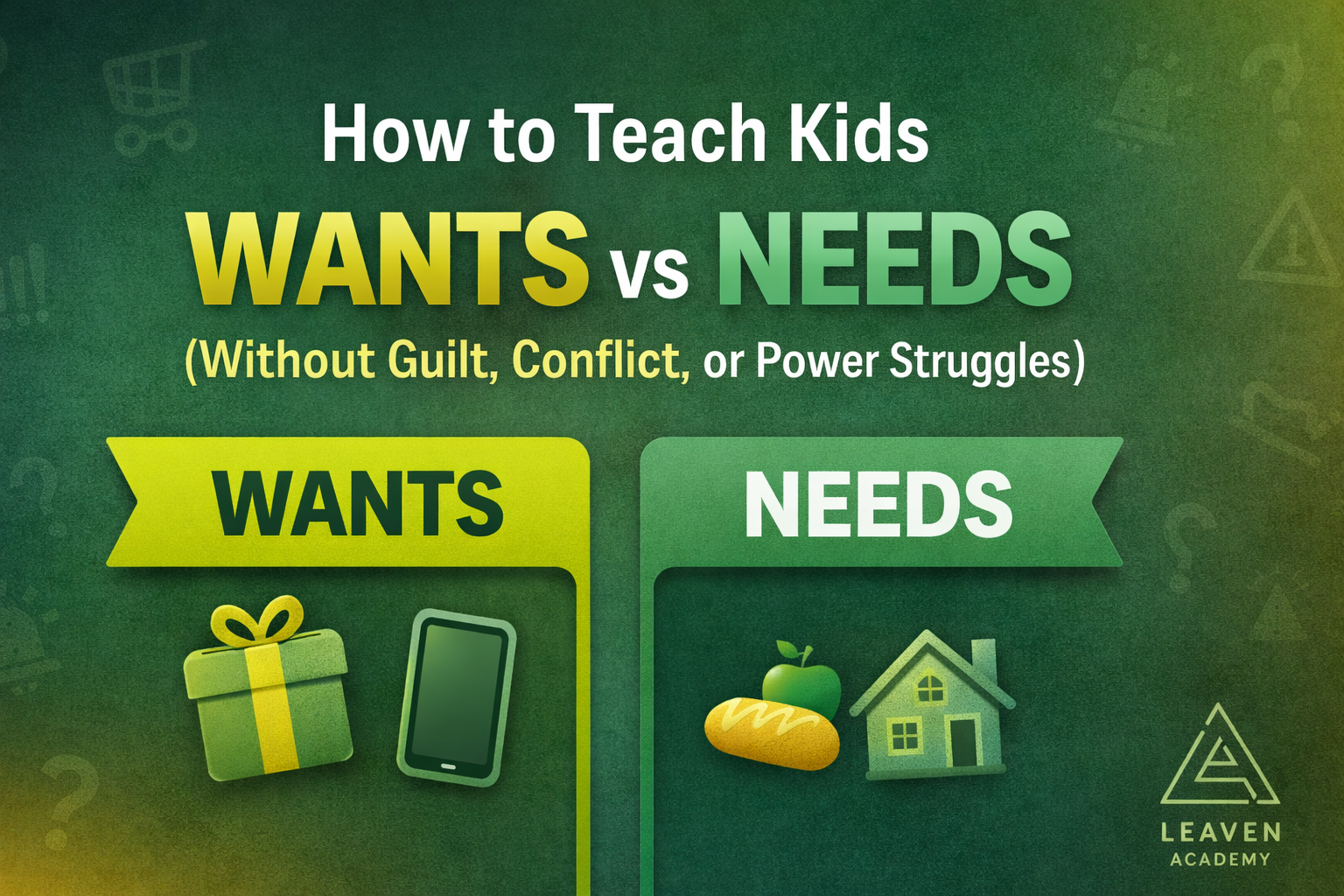
How To Teach Kids Wants VS Needs
Many parents want to teach their children the difference between wants and needs, but unknowingly create a problem in the way they explain it.
One of the most common mistakes I see is when parents frame wants versus needs as a good versus bad issue.
Needs are “good”. Wants are “bad”.
That framing is not only inaccurate — it can be dangerous.
There is nothing wrong with wanting something. At the same time, not every want should be fulfilled immediately. Teaching children wants versus needs is not about morality. It is about decision hierarchy and priority.